Monday, March 15, 2010

Win A Cool T-Shirt from Sidewinder Cycle


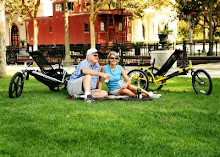
If you already ride a Sidewinder Cycle, you know how comfortable a ride the recumbent trike provides. Now, here’s your chance to look even cooler as you ride your trike. If you are not already a Sidewinder Rider, check our website at SidewinderCycle.com and enter to win the t-shirt. Who knows, that entry could be the start of a three-wheeled adventure.

Starting March 17th - St. Patrick’s Day – Sidewinder is running a contest to win a red Sidewinder t-shirt. How do you win?

Well first, become a Sidewinder fan on Facebook at this link. It’s pretty simple. Just to go the page and click on the Become a Fan widget. If you’d like, you can list the Sidewinder page as one of your Facebook page’s favorites.

Then answer this question: “What would I do to win a Sidewinder Cycle recumbent trike.” Keep it under 150 words please. Once you’ve done that, please send an email to contest@SidewinderCycle.com to let us know you’ve entered. Also, send your contact information and shirt size in that email. We will not be sharing that information with anyone.

Here the other rules:
• The contest will run from March 17 through 12:01 am (PDT) March 29th.
• You must be 18-years-old to enter. Please provide your birthday in the entry.
• You must have a U.S. shipping address.
• The winner will be announced on the Sidewinder Cycle Facebook Fan Page and via email.
• The winner will have 48 hours to respond to the notification that he or she has won.

It’s that simple. Invite your friends. Give them a chance to win too.

Saturday, March 6, 2010

Organization donates over 800 bikes to youth


A generous donation from the International Fellowship of Christians and Jews has allowed for 800 Bedouin children living in the desert in the south of Israel to take part in a regular cycling activity. The donation enables the opening of 25 new cycling clubs in the Abu Basma region of the Negev desert, following two years of pilot work with seventh and eighth graders in the Abu Basma region, and the training of ten Bedouin cycling instructors and support from university student volunteers.

Beyond Sport is a global organization that promotes, develops and funds the use of sport to create positive social change across the world. The goal is to encourage children and youth at the periphery of society to pedal their way forward. The cycling program also includes several national events, when the children are bussed in from the periphery to enjoy games, trips, and lots of fun together. Thus the project also aims at increasing social inclusion of minority groups that are literally at the periphery of mainstream society.
This story is not only a reminder of what we can do to help promote the many benefits of cycling but also as a reminder that one the many activities that we participated as a kid is still an activity that we can participate in as we get older. I encourage everyone to find an a group or organization that is giving back to the community like this and lend a hand.

Tuesday, March 2, 2010

Baby Boomers stay active longer when Cycling

Baby Boomers might be one of the most physically fit generations ever. This was the generation that started the running boom in the ‘70s and the biking boom in the ‘80s. Unlike their parents’ generation, Boomers usually keep exercising well after retirement. And why not? While exercise might necessarily not make one live longer, it does most definitely improve one’s quality of life.

However, while Boomers try to prolong their youth as long as possible through exercise, there are running into some hard truths. One of the most important one is that the human body cannot always stand up to the pounding of running and biking.

Veteran runners wake up one morning with sore knees and hips. Bike riders trying to get into the saddle feel their back screaming at them.

A trip to the doctor is often greeted with the advice to start acting one’s age. The doctor will cut to the truth about the damage being done. The learned physician will counsel taking up something more sedentary, such as golf. But, who ever broke a real sweat swinging a seven iron? And as for aerobic exercise, golf just doesn’t cut it.

There is an answer –a recumbent bike or trike. According to Wikipedia: “A recumbent bicycle is a bicycle that places the rider in a laid-back reclining position. Most recumbent riders choose this type of design for ergonomic reasons; the rider’s weight is distributed comfortably over several square feet of the back and buttocks. On a traditional upright bicycle, the body weight rests on a few square inches of the sit bones, the feet, and the hands.

“Most recumbent models also have an aerodynamic advantage; the reclined, legs-forward position of the rider’s body presents a smaller frontal profile. A recumbent holds the world speed record for a bicycle. Recumbents are available in a wide range of configurations, including: long to short wheelbase; large, small, or a mix of wheel sizes; overseat, underseat, or no-hands steering; and rear wheel or front wheel drive. A variant with three wheels is a recumbent tricycle.”

Recumbent tricycles but have three wheels instead of two. Trikes come in two varieties, the delta, with two rear wheels, and the tadpole, with two front wheels.

The recumbent trike has four attributes that make it attractive to riders:
• The rider does not need to disengage from the pedals when stopped.
• The trike can be geared very low to enable hill and mountain climbing while heavily loaded and at a slow speed, without losing stability.
Trikes are capable of turning sharply without leaning, producing lateral "g forces" similar to sports cars. Recumbent trikes are often more suitable for people with balance problems or disabilities.
• The trike can also be converted into a hand-powered vehicle for people who cannot use their legs.

Enthusiasts list a number of other advantages, including comfort and safety. Since the rider is essentially sitting a chair, there is less strain on the back. Recumbents are safer than upright bikes, riders say, because of their low center of gravity. Trikes are very stable and rarely tip, therefore reducing the chance of injury. Also, because they look so different, drivers tend to see recumbents.

Thursday, February 25, 2010

Many cyclists have ridden around the United States and Canada. Few have done both at the same time. The ride of choice is usually a mountain bike or heavy-duty touring bike. After all, not every bike can handle the different kinds of terrain a rider will encounter on the trek. The bike that’s needed is one that can traverse glaciers, mountains, deserts, jungles and just about every kind of imaginable conditions.

Swiss rider Harry Mueller, 62, feels he has found the perfect ride – a custom-built Sidewinder recumbent trike. A survivor of two heart attacks, a stroke, and a spine injury that almost left him permanently debilitated, Mueller said he’s planning to start his epic journey later this spring.

“Traveling and living outdoors is the driving force of my life,” Mueller said. “I work only to make enough money to finance my next trip or expedition. When money gets short, I go work again. I take whatever job I get as long it is interesting, or I can make the money I need in a short time.”

It has been Mueller’s dream to explore the world from a bicycle saddle. The trip he has always wanted to make is on what he calls "The Dream Road of the World." The route will take the Swiss explorer from the southernmost point in South America- Ushuaia in Terra del Fuego - to the northernmost of North America -Prudhoe Bay, Alaska.

To make the trip, Mueller decided he needed to ride a recumbent trike. He came to California to find one. There he discovered Sidewinder Cycle in Fillmore, Calif. He made an appointment with Sidewinder owners Jim and Linda Nunes to check the trikes they build. The couple met Mueller at the Santa Clarita train station with three trikes. Mueller test rode one and fell in love. He particularly liked the back wheel steering and the front wheel differential.

Mueller told the Nunes about his plan to ride the length and breadth of North and South America. The couple discussed sponsoring Mueller by providing a Sidewinder. A few days later they decided to help the Mueller out and agreed to donate a trike to his effort.

Mueller has not yet settled on a starting date for the trip. He is looking for other sponsors to provide such things as a GPS, a satellite phone, emergency supplies and the other necessities when one plans to ride over 25,000 miles.

Mueller’s planned route is:
• Starting in Fillmore, Calif., and riding up the US West Coast to the most northernmost point of North America – Prudhoe Bay in Alaska.
• The second leg of the trip will take Mueller back to Canada. He will ride across the country and enter in the United States on the East Coast and ride south to Florida.
• At this point in the journey, Mueller has a decision to make:
o Either he rides back to Fillmore across the southern United States.
o Or he will island hops across the Caribbean and goes to South America.
o Or, he rides to Texas, through Mexico and Central America and then into South America.
• If Mueller goes to South America, he will ride along the east side of the continent to the southernmost point in South America, Ushuaia in Terra del Fuego.
• Going north, Mueller will ride up the west side of South America, going to either Columbia or Venezuela.
• Once on the northern part of the continent, Mueller has another decision to make:
o If he went south through Texas, Mueller will then back to North America through the Caribbean and ride back to Fillmore.
o Or, if he went south through the Caribbean, he will ride north through Texas and then back to Fillmore.

Thursday, February 18, 2010

The Future of Recumbent Bicycle & Recumbent Trike design


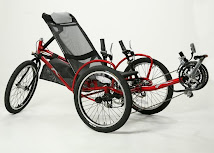
I wanted to take a moment to acknowledge future recumbent bike and recumbent trike designs that will push the industry and those that are on the fringes. This recumbent human powered machine (left) was found recently and I immediately was drawn to the detail, lines and accessibility this trike offered.
The recumbent trike designers of this trike took into account current transportation issues and needs including sleek design, ergonomics and if needed electric assist engine for no-carbine emission. With needs satisfied one of the main issues of recumbents in general is the design style aesthetics. We have even experienced this with comments including; what is that, it looks like a modified wheel chair, ect... This design answers the style question.
I have shared this recumbent trike design with a variety of people representing all age demographics and the response is always the same, WOW! This recumbent trike no only looks good but also provides a comfortable ride. So, what are we waiting for and why are not more people jumping on recumbents.
We at Sidewinder Cycle are dedicated to pushing our designs further than we have ever done in our history. We are just not planning for today but for years ahead that our unique front wheel drive with rear wheel steering trikes can incorporate a sleeker aerodynamic frame structure with comfort being the center point.
So keep in touch and send your design suggestions.

Thursday, February 11, 2010

Pedal to a Healthy lifestyle in comfort on a recumbent

Energy on wheels was part of the title of an article recently about a 95 year old lady that goes to the gym twice a week to participate in a "Spinning" class. Dorothy, the 95 year old, still drives herself to class. The class is packed with seniors with an age rage from 70 - 90 years old. The class not only provides health benefits but opens the doors to socializing with others to ward off the loneliness.

Dorothy has chosen to do the indoor spinning class because she feels "safer" riding indoors even though the seat and positioning is uncomfortable for her and others. Most in the class had knee, back or shoulder problems when they started taking the class and Pettett has osteoporosis. The last time she was on a “regular” bicycle was 10 to 15 years ago, she recalls. The effort ended in disaster — she and a passenger crashed into a wall!

Okay, several items jumped out at me. First, she and a passenger! Was she on a tandem bike, riding on the handlebars or what? Also, where were they riding that they "crashed" into a wall?
Recommendation: receive qualified bicycle, recumbent or recumbent trike training before going out for a ride. Even though a "recumbent trike" looks safe because you have three wheels, there is still a learning curve that takes place. Most importantly, your in a different riding position now and when turning, your body positioning is crucial to safe cornering. Braking, learn how to apply the brakes for different road, traffic and braking conditions. When riding, choose safe trails that do not have walls or obstacles that pose a riding challenge.

Second, knee problems, back, shoulder and the list goes on, so why are they riding in the up-right positioning? Comfort and recumbent bikes/trikes were designed primarily from the need of older riders along with those with injuries an option for safe and comfortable riding outdoors. Recumbent trikes have been described as a lounge chair on wheels. Quite often we have first time riders ask if they could take a nap because it is so comfortable. Additionally, Sidewinder Cycle is one of the leaders in adapting trikes to riders special needs. For example, braking and control levers fitted to one side of the trike because some riders have better use of one side of their body.

Lastly, she does not stand up to pedal on the bike when the class is asked to "kick it" because she gets dizzy, so she sits. How safe is this? This is crazy! It is still not safe even though they are indoors because of the height of the stationary bikes the class is using. This is another reason why we have so many riders switching to recumbent trikes because if the do get dizzy, they are already sitting in a reclined position with all three wheels on the ground. We have fitted Sidewinder trikes to those that have balance and dizziness challenges.

So please, what we are sometimes convinced what is safe is sometimes the complete opposite. After 15 years of building recumbents we have received numerous letters and feedback all thanking us for making a safe, comfortable and durable riding option.

Thursday, February 4, 2010

Bicycling & Walking statistics in the United States:

The Alliance for Walking and Biking just released their 2010 Benchmarking report that covers statistics for bicycling and walking in the United States. Statistics that jumped out were:


Bicycling and Walking Levels
• 9.6% of all trips are by bicycle (0.9%) or foot (8.7%).
• 3.3% of commuters nationwide are bicyclists (0.5%) or pedestrians (2.8%).
• Residents of the largest U.S. cities are 1.8 times more likely to walk or bicycle to work than the national average.
• From 2000 to 2007, the number of commuters who bicycle to work increased by 42%.

Bicycle and Pedestrian Safety
• 13.1% of all traffic fatalities in the U.S. are bicyclists (1.8%) or pedestrians (11.3%).
• In the 51 largest U.S. cities, 4.8% of trips are by foot and 0.8% are by bicycle, yet 26.5% of traffic fatalities are pedestrians and 3.0% are bicyclists.
• Seniors are the most vulnerable age group comprising 9% of walking trips and 4% of bicycling trips, yet accounting for 19% of pedestrian fatalities and 9% of bicyclist fatalities.

Funding for Bicycling and Walking
• States spend just 1.2% of their federal transportation dollars on bicycling and walking. This
amounts to just $1.29 per capita.

Public Health and Bicycling and Walking
• While bicycling and walking levels fell 67% between 1960 and 2000, obesity levels increased by 241%.
• Between 1966 and 2001, the number of children who bicycled or walked to school fell 68%, while the percentage of obese children rose 367%.
• In general, states with the highest levels of bicycling and walking have the lowest levels of obesity, hypertension (high blood pressure), and diabetes and have the greatest percentage of adults who meet the recommended 30-plus minutes a day of physical activity.

In conclusion, the number of people participating in cycling has increased but so has the number of incidents. Cycling Safety
  • Lookout for them (drivers) before they look out for you.
  • Recumbent cycling flags on your recumbent bike or trike
  • Helmet
  • Bright colors (clothing)
  • Ride on bike paths when possible
  • Obey the laws of the road

Have fun, be safe!